College auditions come with their own vocabulary. Here’s a plain-English glossary of the terms you’ll run into during the process. Swipe through the slides below, and keep it handy as you build your list.
The full glossary
Degrees and training
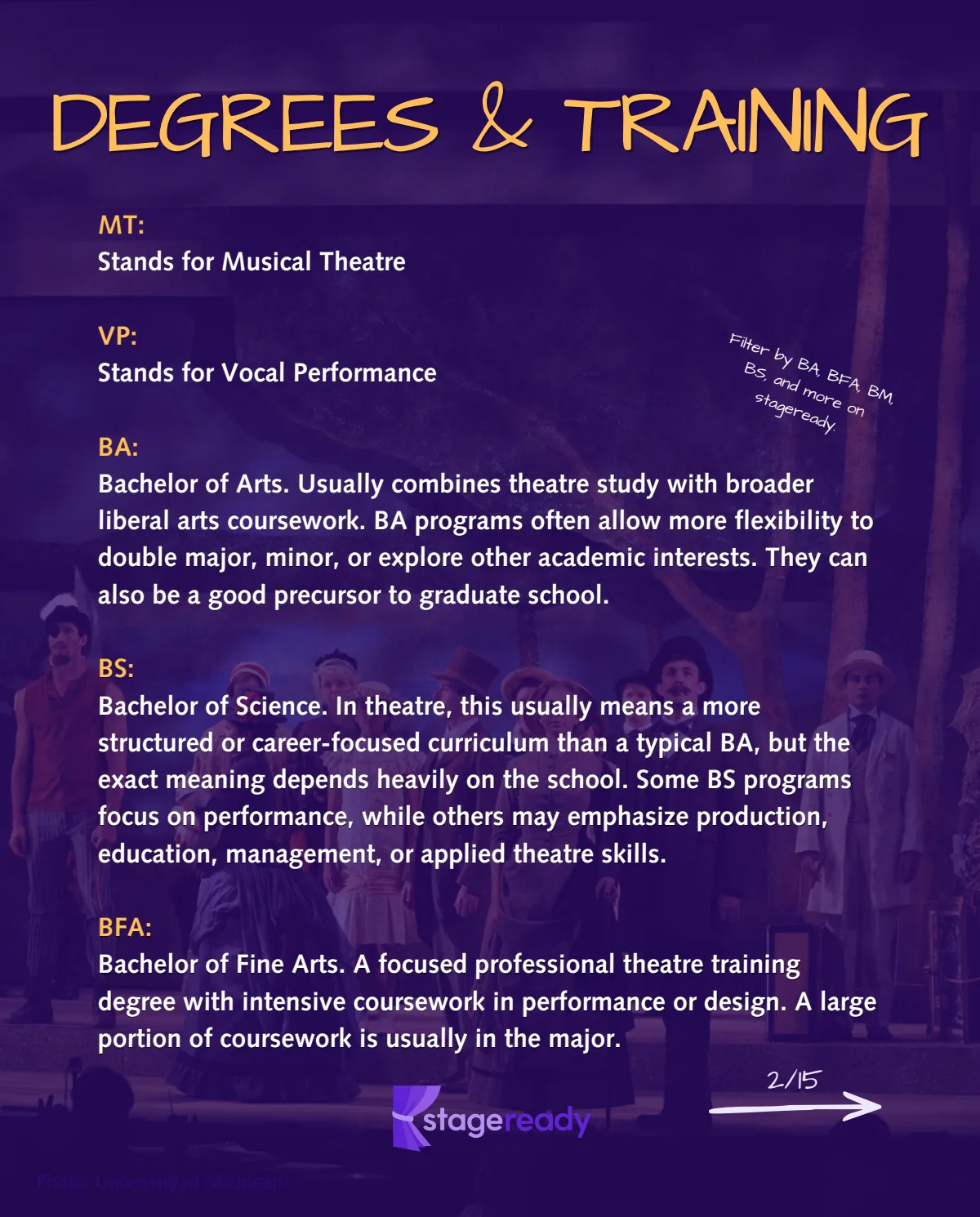
MT. Musical Theatre.
VP. Vocal Performance.
BA (Bachelor of Arts). Usually combines theatre study with broader liberal arts coursework. BA programs often allow more flexibility to double major, minor, or explore other academic interests, and can be a good precursor to graduate school.
BS (Bachelor of Science). In theatre, usually a more structured or career-focused curriculum than a typical BA, though the exact meaning depends on the school. Some BS programs focus on performance, while others emphasize production, education, management, or applied theatre.
BFA (Bachelor of Fine Arts). A focused professional theatre training degree with intensive coursework in performance or design. A large portion of coursework is usually in the major.
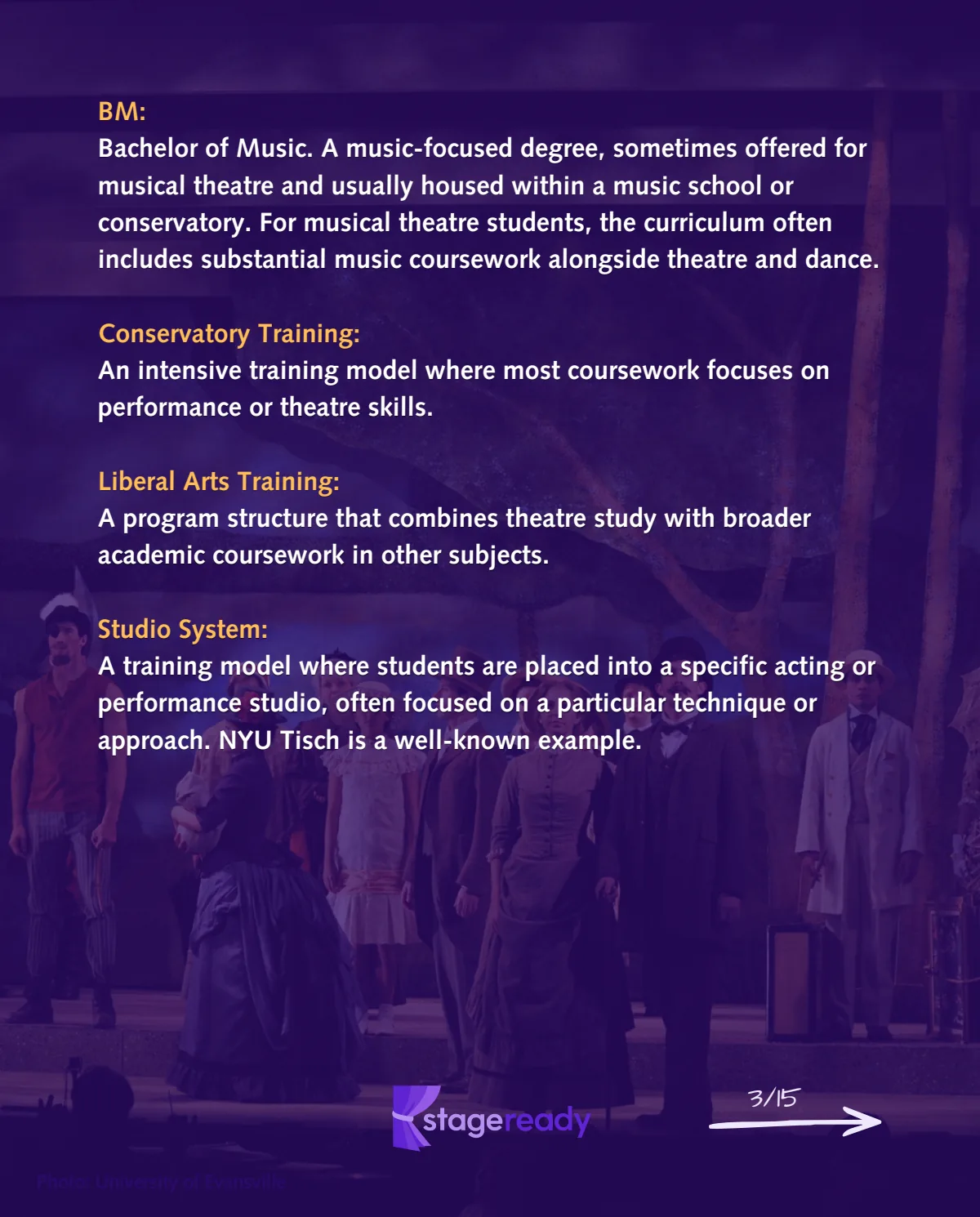
BM (Bachelor of Music). A music-focused degree, sometimes offered for musical theatre and usually housed within a music school or conservatory. The curriculum often includes substantial music coursework alongside theatre and dance.
Conservatory training. An intensive model where most coursework focuses on performance or theatre skills.
Liberal arts training. A program that combines theatre study with broader academic coursework in other subjects.
Studio system. Students are placed into a specific acting or performance studio, often focused on a particular technique. NYU Tisch is a well-known example.
Applications
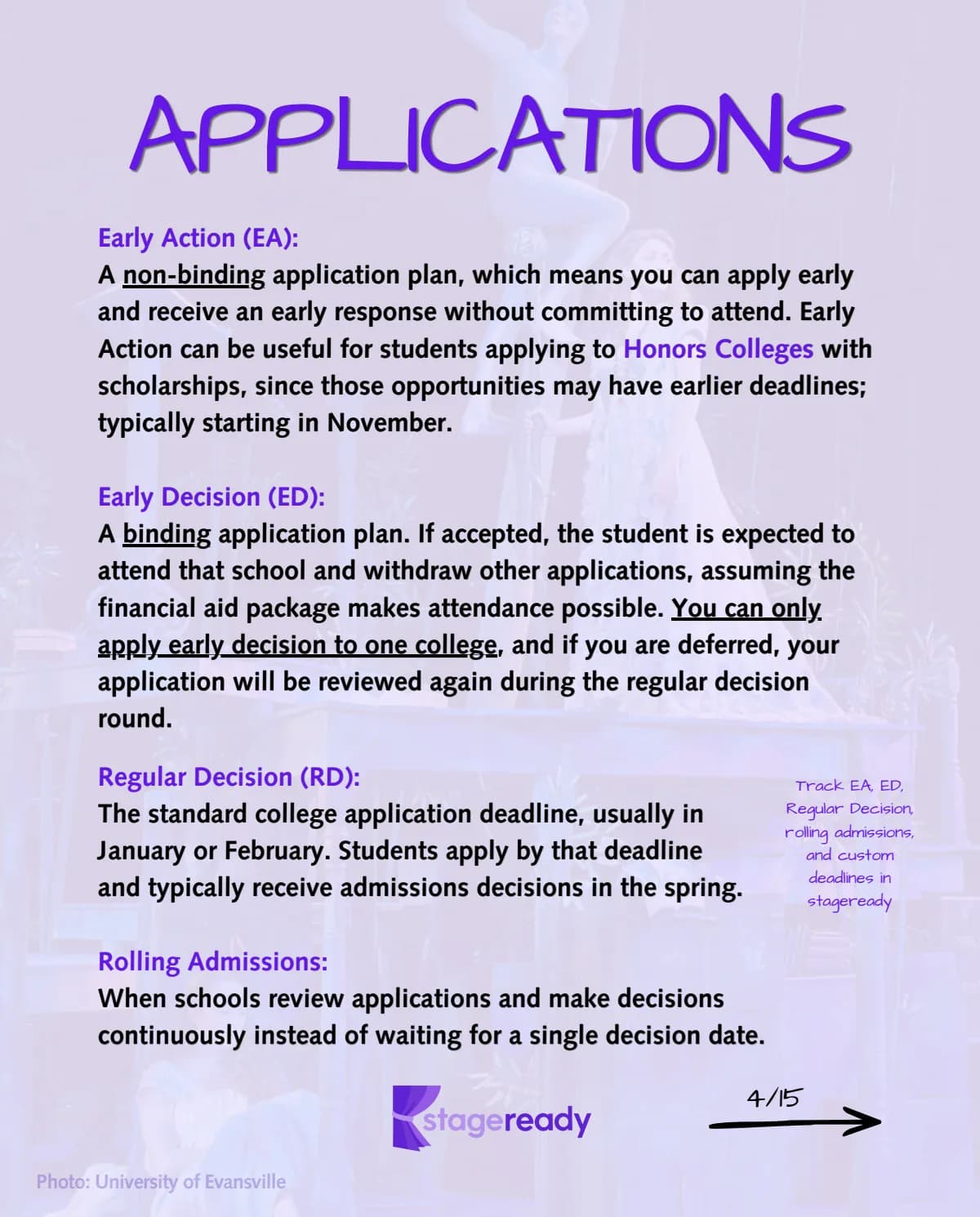
Early Action (EA). A non-binding early application plan: you apply early and receive an early response without committing to attend. It can help with Honors Colleges and scholarships that have earlier deadlines, typically starting in November.
Early Decision (ED). A binding plan. If accepted, you are expected to attend and withdraw your other applications, assuming the financial aid package makes it possible. You can only apply early decision to one college; if you are deferred, you are reconsidered in the regular round.
Regular Decision (RD). The standard deadline, usually in January or February, with admissions decisions in the spring.
Rolling admissions. Schools review applications and make decisions continuously instead of waiting for a single date.
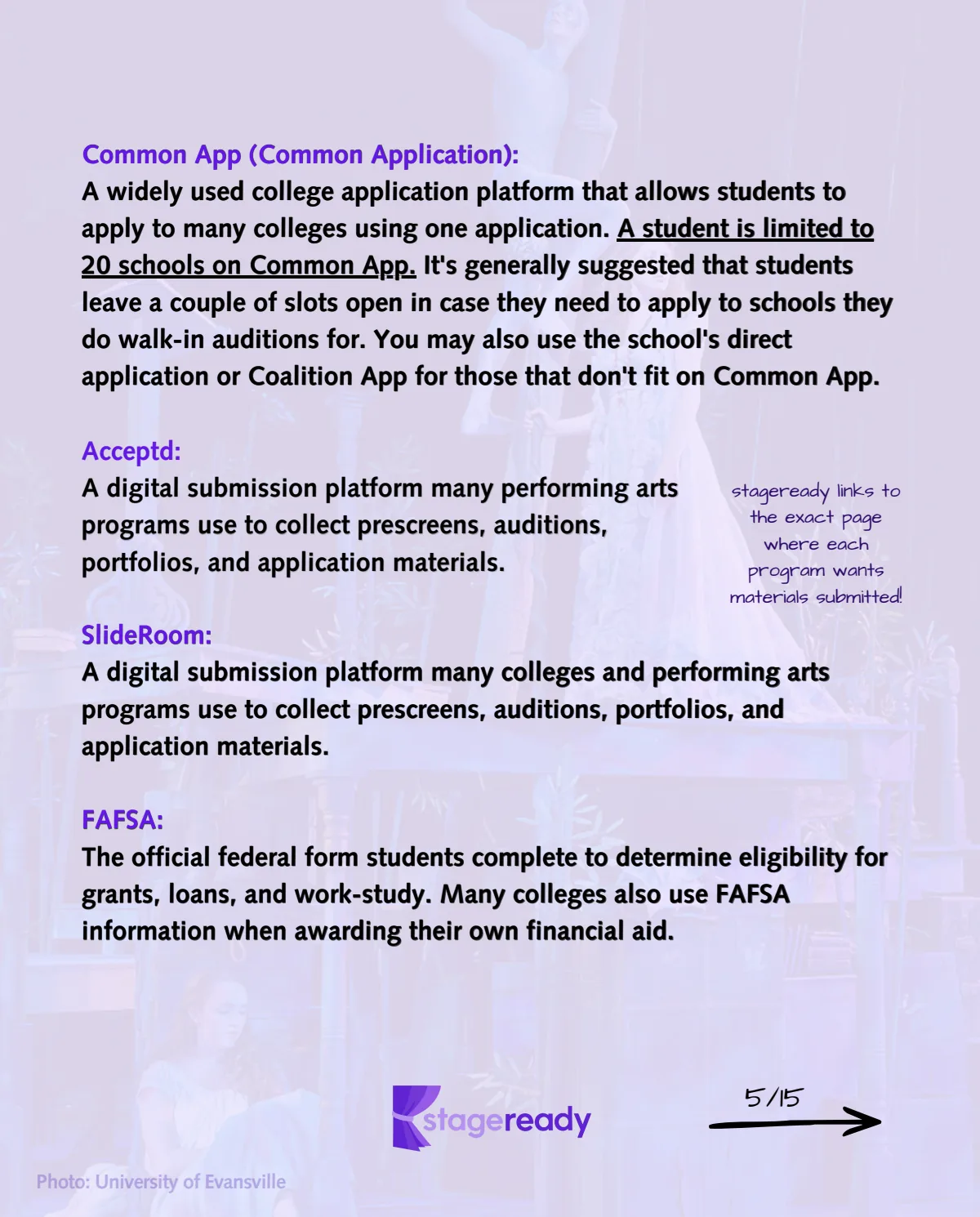
Common App. A widely used platform that lets you apply to many colleges with one application (limited to 20 schools). It is smart to leave a couple of slots open in case you need to apply to walk-in audition schools. You can also use a school's direct application or the Coalition App.
Acceptd. A digital submission platform many performing arts programs use to collect prescreens, auditions, portfolios, and application materials.
SlideRoom. A digital submission platform many colleges and programs use to collect prescreens, auditions, portfolios, and application materials.
FAFSA. The federal form that determines eligibility for grants, loans, and work-study; many colleges also use it when awarding their own aid.
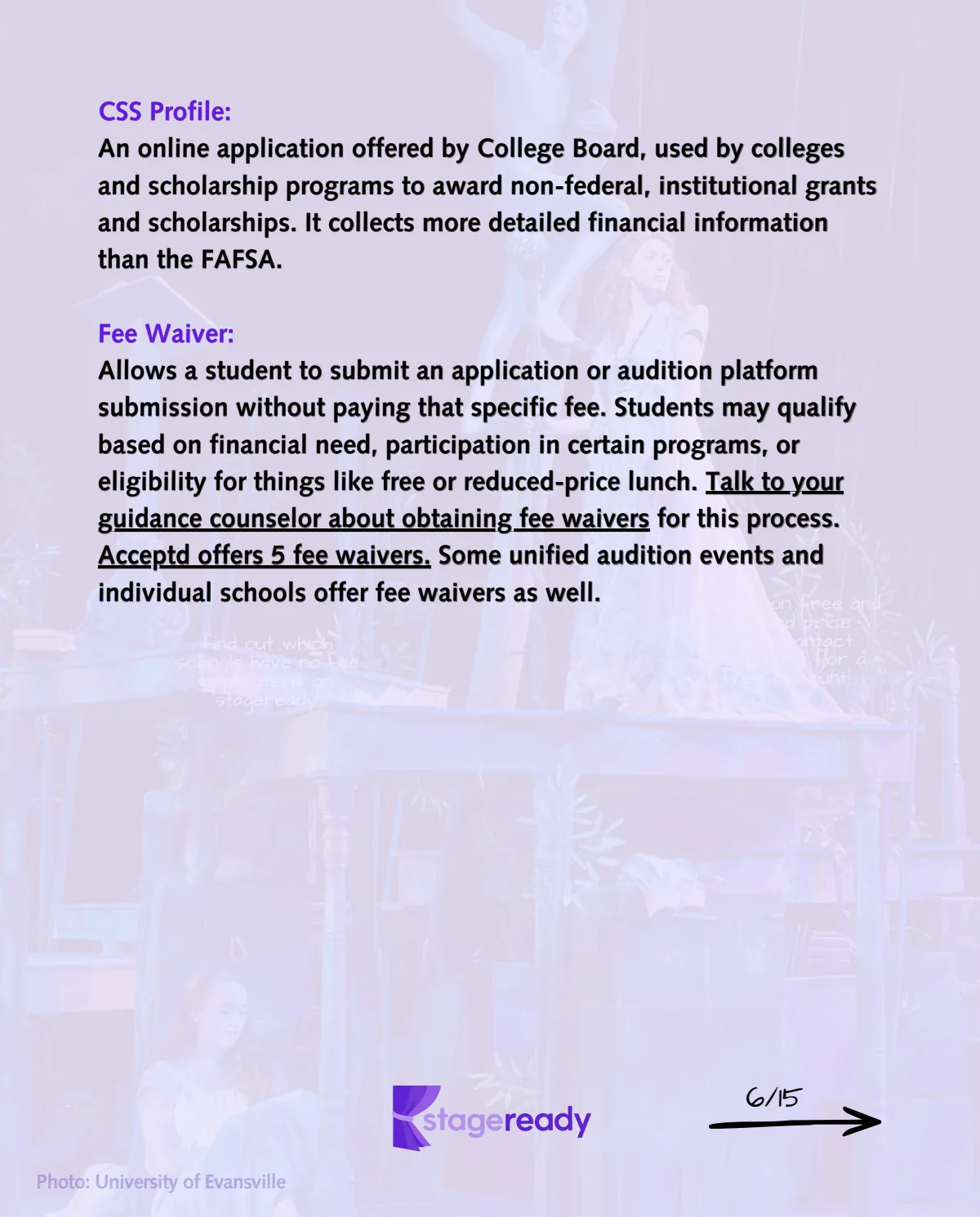
CSS Profile. A College Board application used by some colleges and scholarship programs to award non-federal institutional aid; it collects more detail than the FAFSA.
Fee waiver. Lets you submit an application or audition-platform fee without paying it. You may qualify based on financial need or programs like free or reduced-price lunch. Acceptd offers five fee waivers, and some unified events and individual schools offer them too.
Artistic process
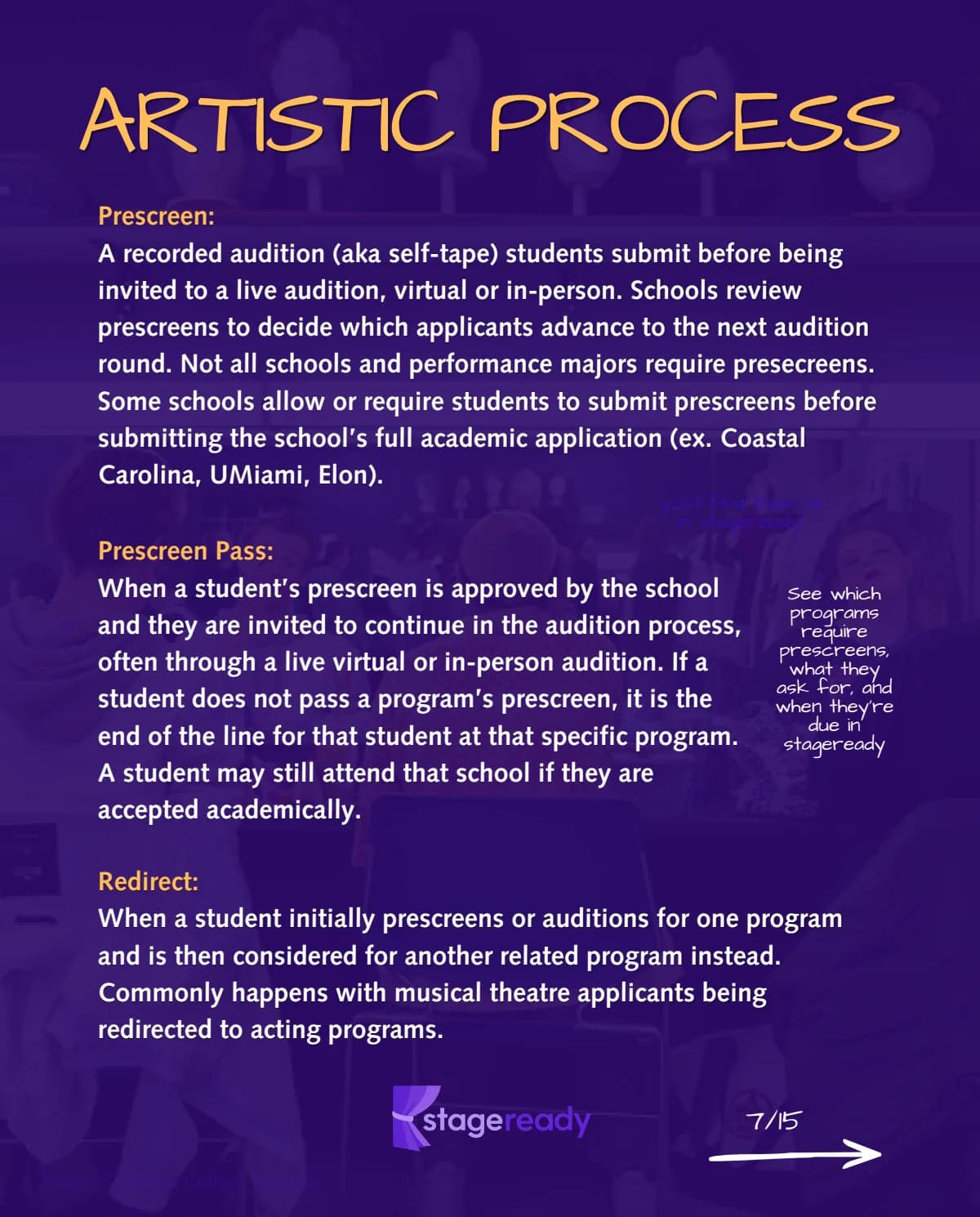
Prescreen. A recorded audition (self-tape) you submit before a live audition; schools review prescreens to decide who advances. Not all schools or majors require them, and some require a prescreen before the full academic application (for example Coastal Carolina, UMiami, and Elon).
Prescreen pass. When your prescreen is approved and you are invited to continue, often to a live virtual or in-person audition. If you do not pass, it is the end of the line for that program, though you may still attend academically.
Redirect. When you audition for one program and are then considered for another related program instead; this commonly happens with musical theatre applicants redirected to acting.
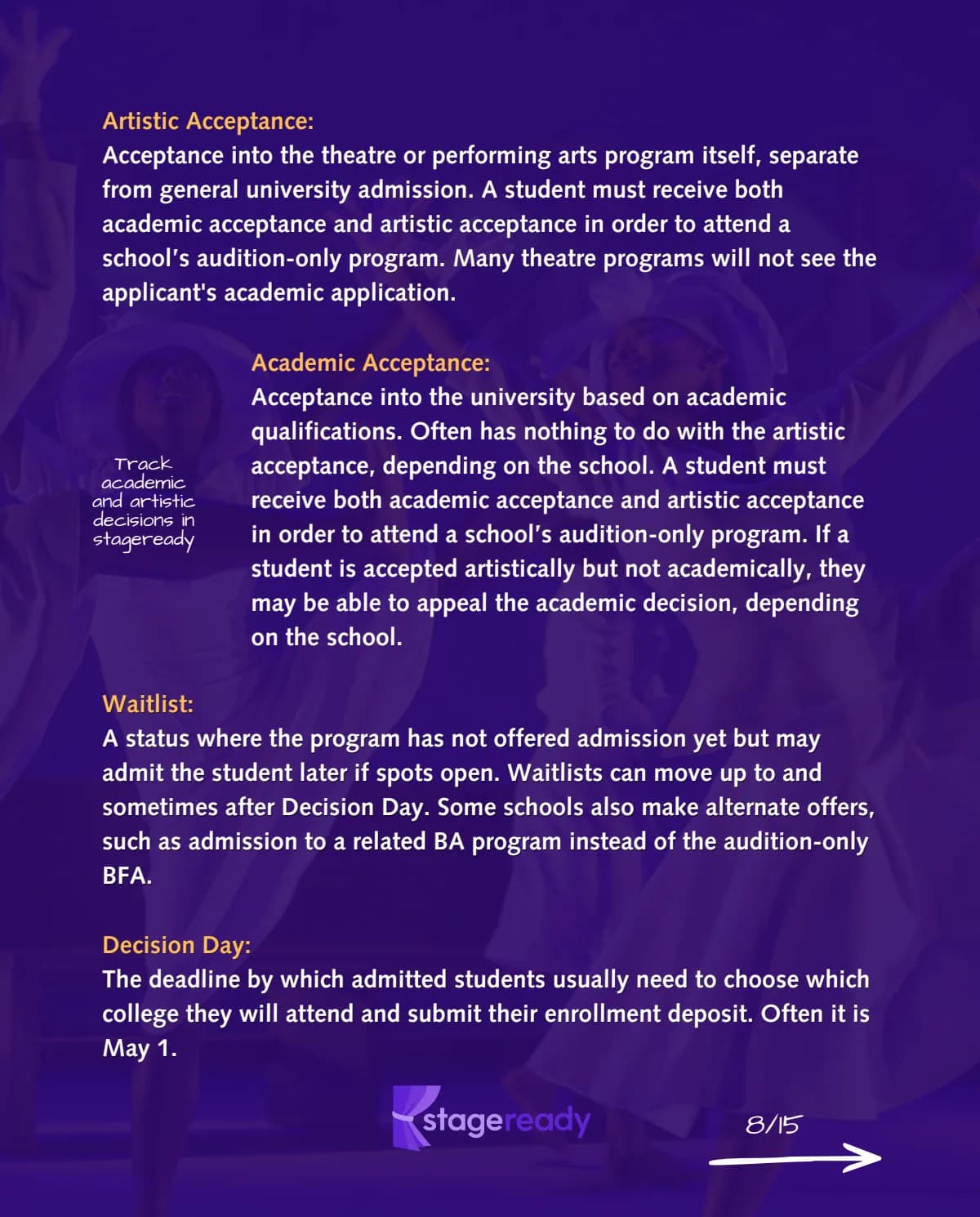
Artistic acceptance. Acceptance into the performing arts program itself, separate from university admission. You need both academic and artistic acceptance to attend an audition-only program.
Academic acceptance. Acceptance into the university based on academic qualifications, often independent of the artistic decision. If you are accepted artistically but not academically, you may be able to appeal.
Waitlist. The program has not offered admission yet but may later if spots open; waitlists can move up to and even after Decision Day. Some schools also make alternate offers, such as a related BA instead of the BFA.
Decision Day. The deadline to choose a college and submit your enrollment deposit, often May 1.
Audition materials
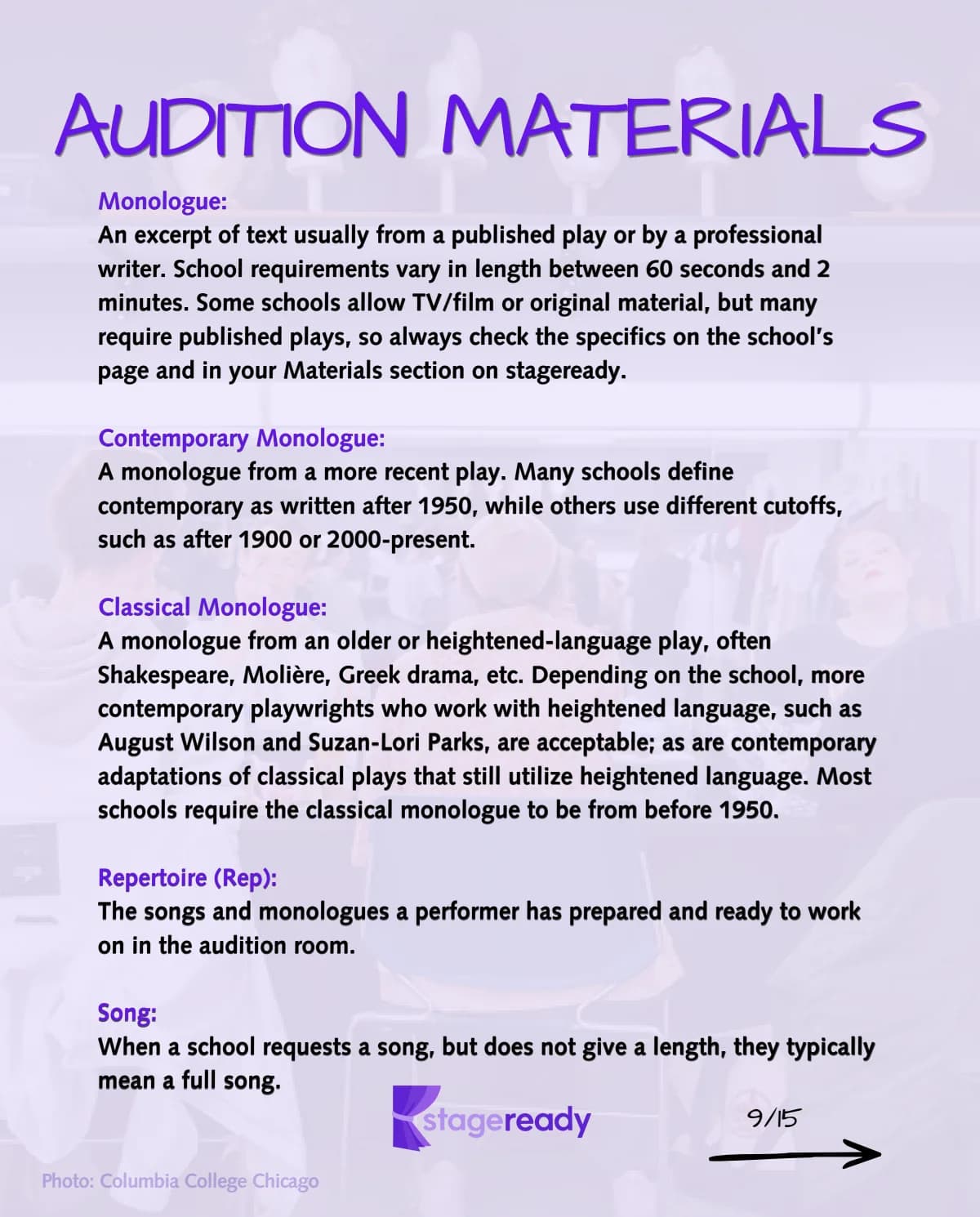
Monologue. An excerpt usually from a published play; lengths vary from 60 seconds to 2 minutes. Some schools allow TV, film, or original material, but many require published plays, so check each school.
Contemporary monologue. A monologue from a more recent play; many schools define contemporary as written after 1950, while others use different cutoffs.
Classical monologue. A monologue from an older or heightened-language play, often Shakespeare, Molière, or Greek drama. Some schools accept heightened-language contemporary writers like August Wilson and Suzan-Lori Parks; most require the classical piece to be from before 1950.
Repertoire (rep). The songs and monologues you have prepared and ready to work on.
Song. When a school requests a song without giving a length, they usually mean a full song.
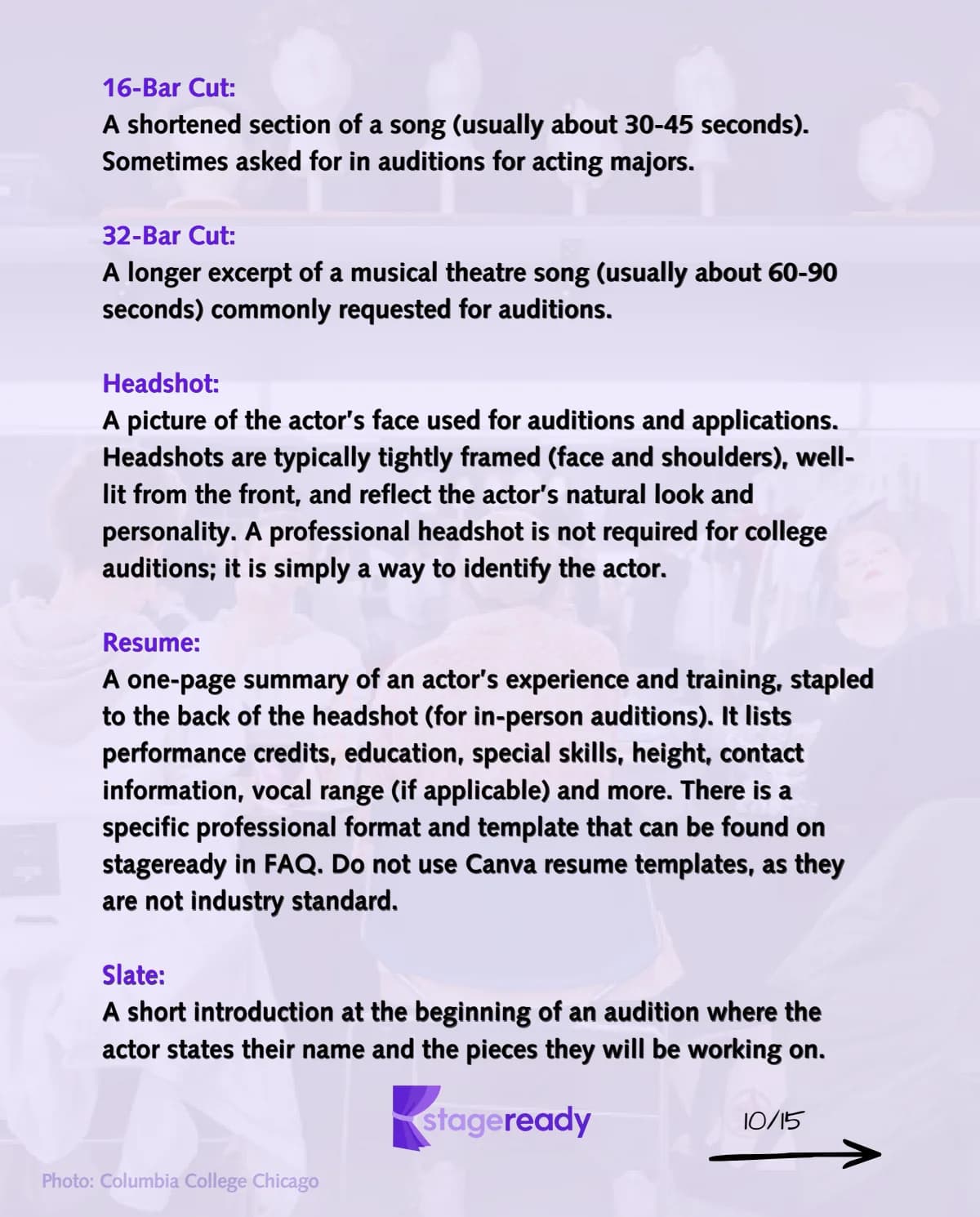
16-bar cut. A shortened section of a song, about 30 to 45 seconds, sometimes asked of acting majors.
32-bar cut. A longer excerpt, about 60 to 90 seconds, commonly requested in auditions.
Headshot. A picture of the actor's face for auditions and applications, typically tightly framed, well lit, and natural. A professional headshot is not required for college auditions.
Resume. A one-page summary of your experience and training, stapled to the back of the headshot for in-person auditions. A standard template is on stageready's FAQ; avoid Canva resume templates, which are not industry standard.
Slate. A short introduction where you state your name and the pieces you will perform.
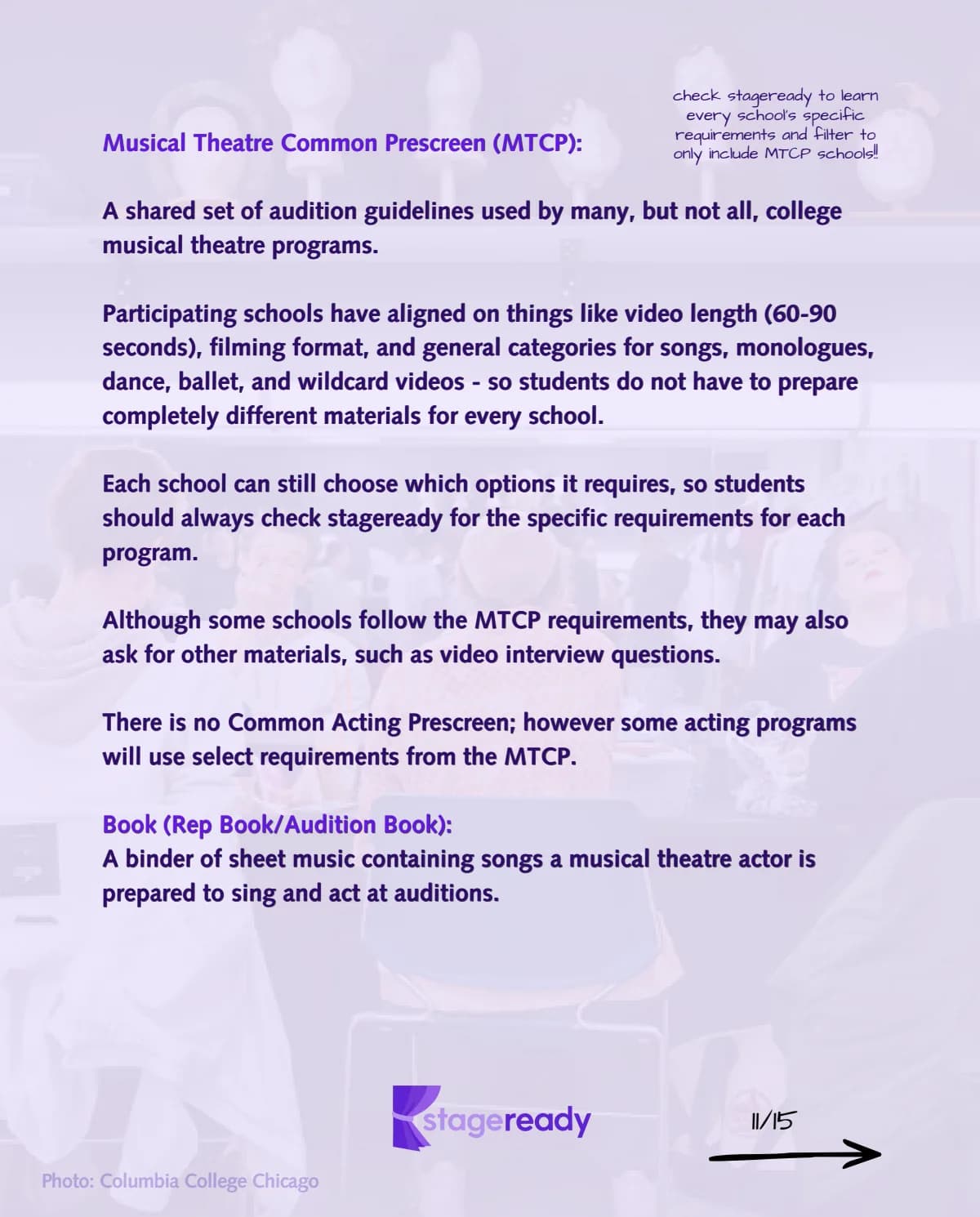
MTCP (Musical Theatre Common Prescreen). A shared set of guidelines used by many, but not all, college musical theatre programs, covering things like video length, format, and categories for songs, monologues, dance, ballet, and wildcard videos, so students do not prepare completely different materials for every school. Each school still chooses which options it requires. There is no Common Acting Prescreen, though some acting programs borrow MTCP requirements.
Book (rep book or audition book). A binder of sheet music with the songs a musical theatre actor is prepared to sing.
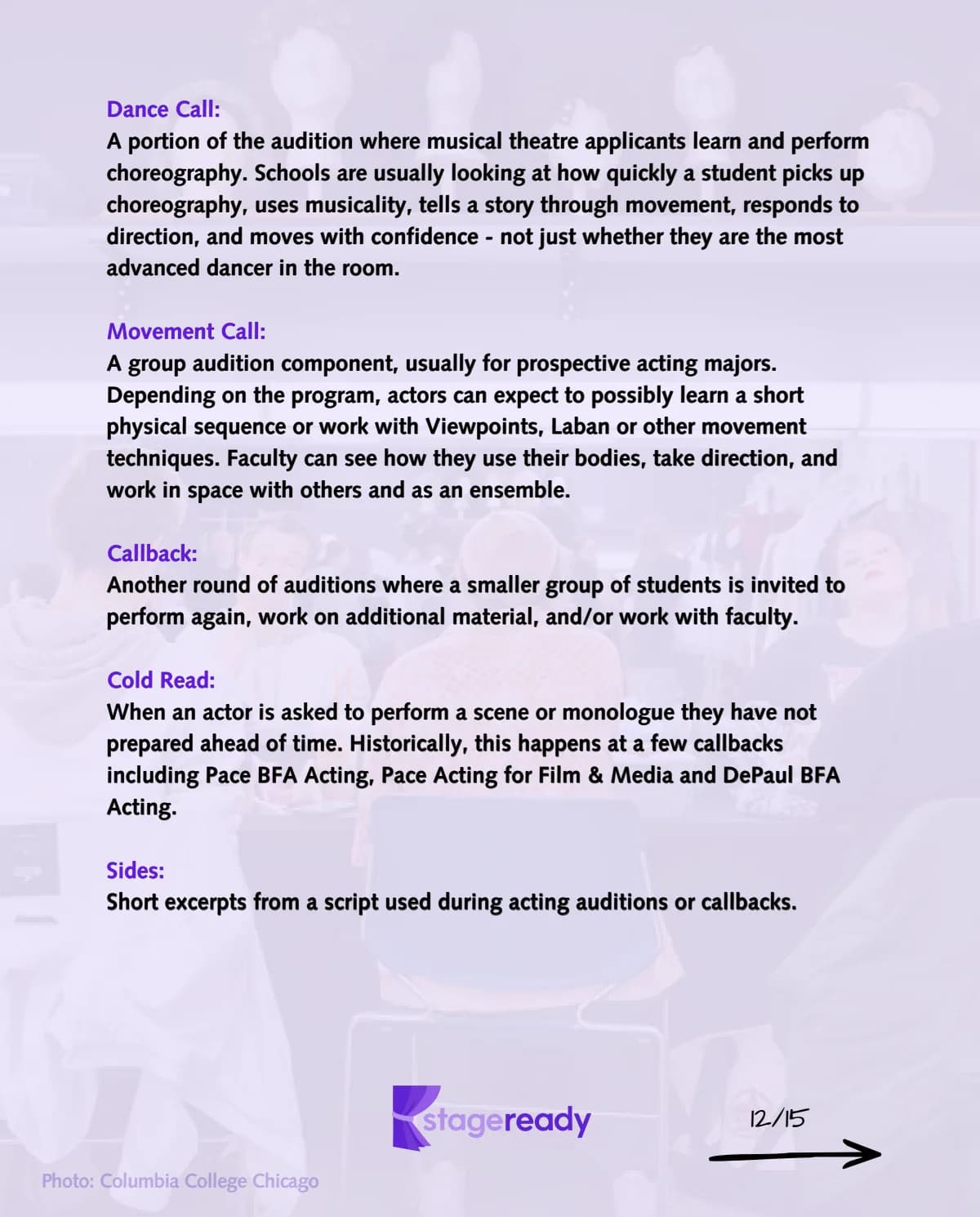
Dance call. A portion of the audition where musical theatre applicants learn and perform choreography; faculty look at how quickly you pick it up, your musicality, storytelling, and confidence, not just technical level.
Movement call. A group component, usually for acting majors, that may involve a short physical sequence or work with Viewpoints, Laban, or other movement techniques.
Callback. Another round where a smaller group performs again, works on additional material, and/or works with faculty.
Cold read. Performing a scene or monologue you have not prepared ahead of time; this happens at a few callbacks, including Pace BFA Acting, Pace Acting for Film and Media, and DePaul BFA Acting.
Sides. Short script excerpts used during acting auditions or callbacks.
Auditions
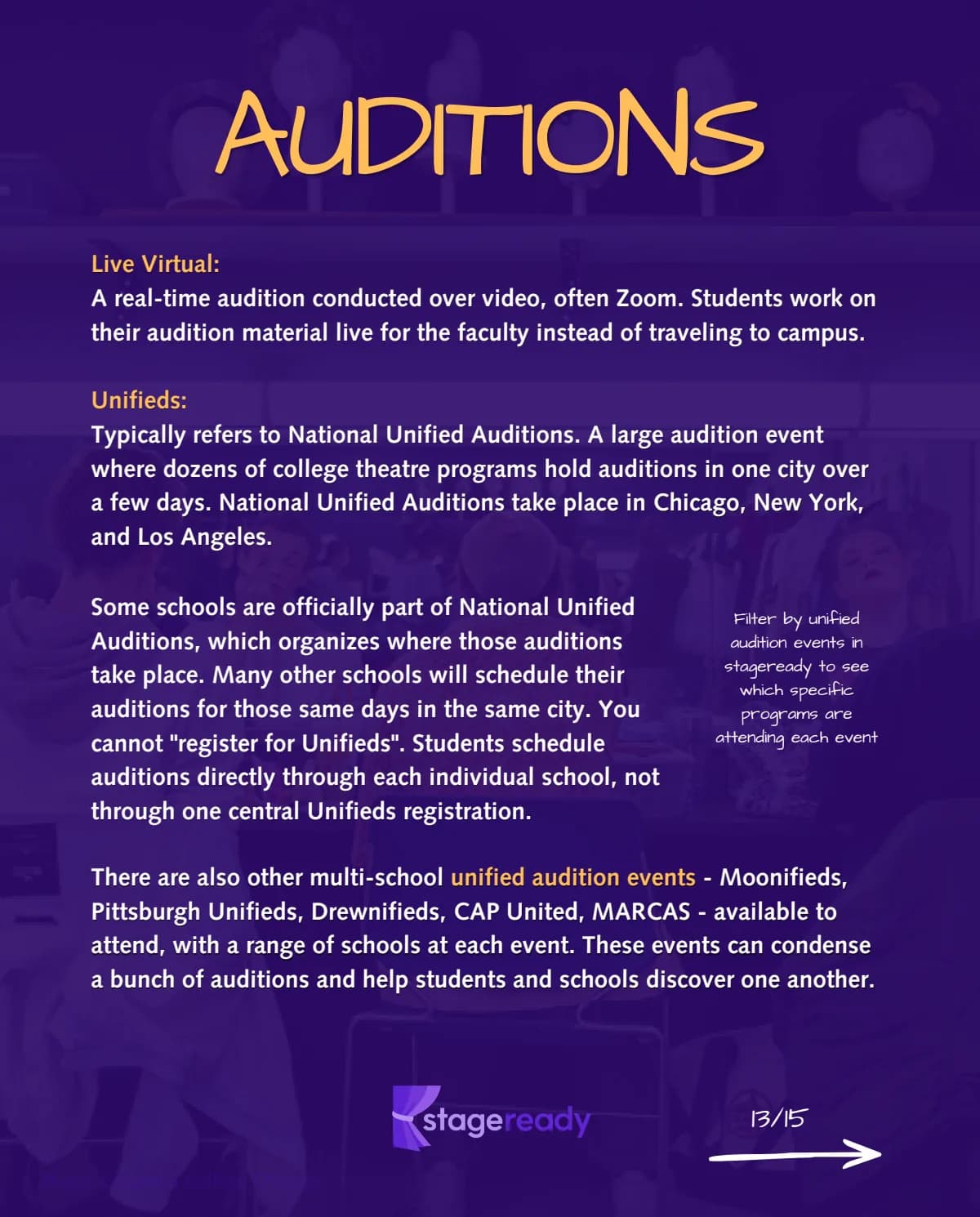
Live virtual. A real-time audition over video, often Zoom. Choosing live virtual will not hurt your chances.
Unifieds. Usually National Unified Auditions, a large event where dozens of programs hold auditions in one city (Chicago, New York, and Los Angeles). You cannot register for Unifieds; you schedule auditions directly with each school. Other multi-school events include Moonifieds, Pittsburgh Unifieds, Drewnifieds, CAP United, and MARCAS.
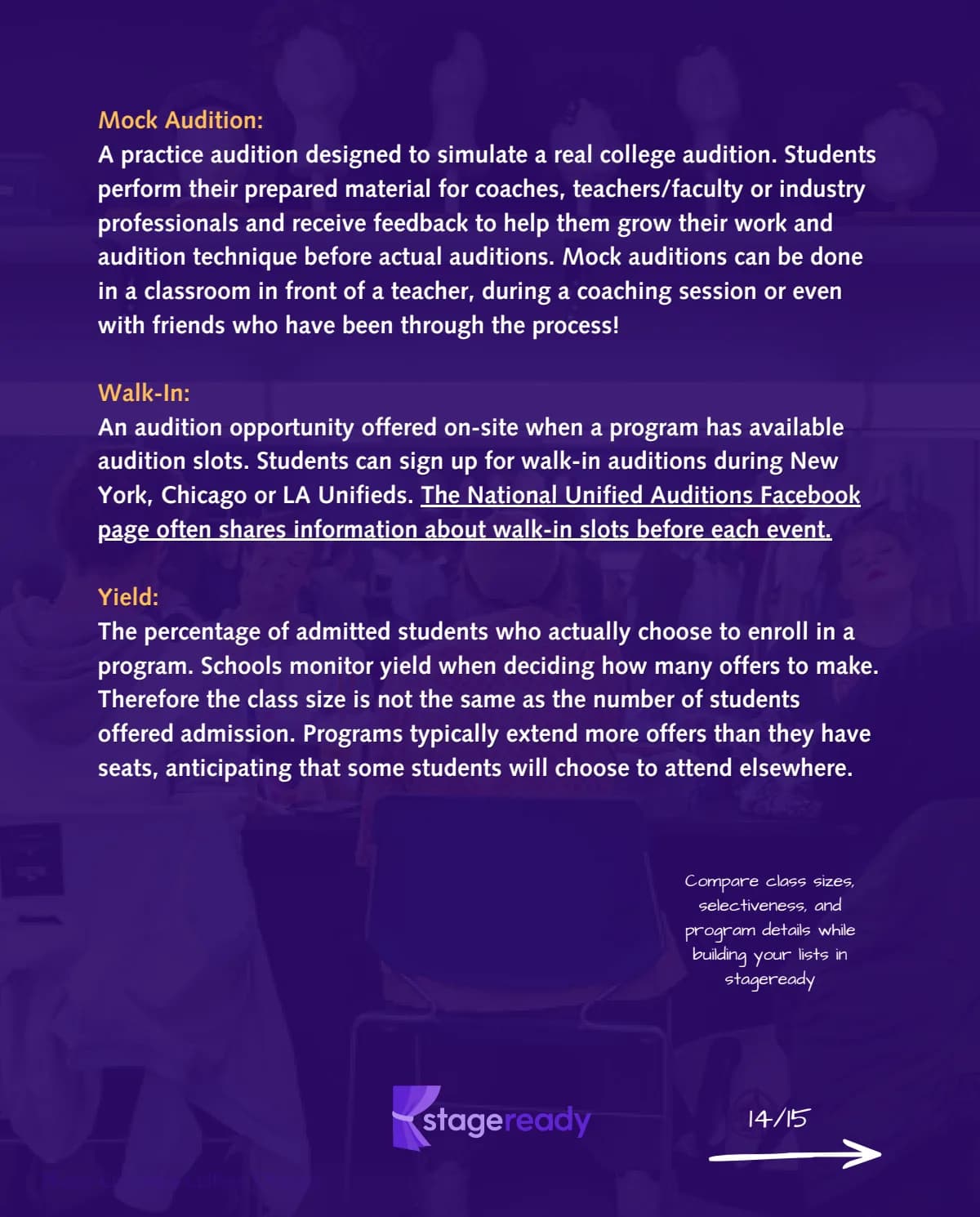
Mock audition. A practice audition that simulates the real thing; you perform for coaches, teachers, or industry professionals and receive feedback before your actual auditions.
Walk-in. An on-site audition slot offered when a program has availability; you can sign up during New York, Chicago, or LA Unifieds.
Yield. The percentage of admitted students who actually enroll. Schools watch yield when deciding how many offers to make, so class size is not the same as the number of students offered admission.
Ready to put these terms to work? Browse programs to compare requirements, prescreens, and deadlines, all in one place.
Ready to find your perfect program?
Explore 10850+ performing arts programs, track audition deadlines, and organize your college search.
Get Started Free